Showing posts with label mobile. Show all posts

Friday, 28 January 2011

Egypt falls off the grid


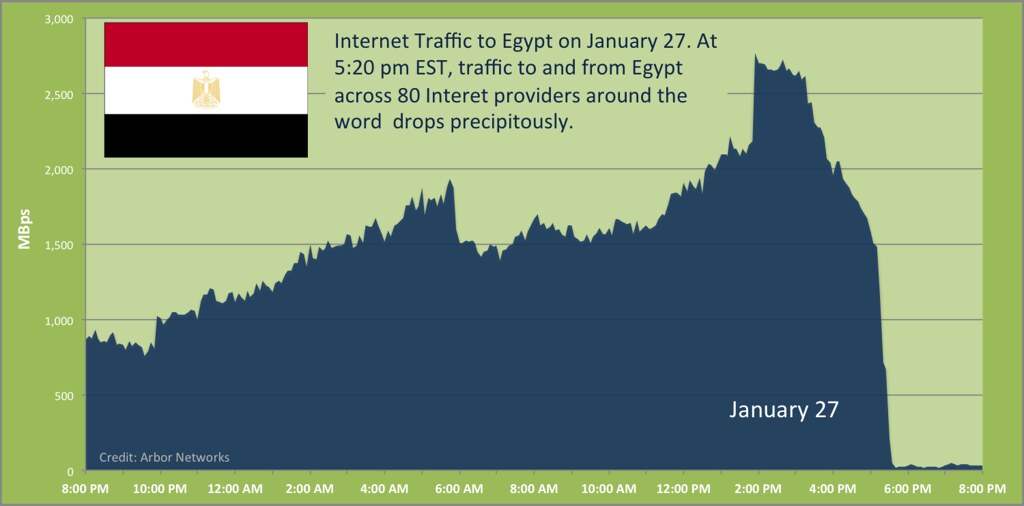
I’ve been catching up on Twitter feeds from and about Egypt and the communications shutdown. Most updates are from 13-15 hours ago, then silence from Twitter inside Egypt. Absolutely incredible the speed at which the government shut providers down. And this blog post is undoubtedly already out of date.


http://farm6.static.flickr.com/5292/5394246995_11ac170497_b.jpg

A look at the Twitter feeds reflects the dissention and despair at what has happened – accusing mobile operators of “colluding” with the government.

Vodafone releases a statement, which read:

All mobile operators in Egypt have been instructed to suspend services in selected areas. Under Egyptian legislation the authorities have the right to issue such an order and we are obliged to comply with it. The Egyptian authorities will be clarifying the situation in due course

It’s impossible to get any information on the ground, given there are no phone lines, no Internet connections and no way to access services, like Facebook or Twitter, in or out of the country. It makes it much easier for rumours to fly and doubt to come in as to whether mobile operators were forced, agreed to, were threatened to close off their networks..

You suddenly realise again how dependent we have become on communication channels and how we rely on information sources online and across networks.

It seems the Internet went first, with mobile calls and SMS stopping. It was still possible to access Twitter and Facebook on mobile devices, until all of those services were shut off too.

A few links to some stories below, but changing so fast, these are really only background info now.

However, I think this will be a case study and a point of discussion for some time to come. While Tunisia was hailed as a result of youth, citizen activism, driven by social media and mobile connectivity, Egypt shows that the power can still be shifted by turning off the source.

It’s a developing story, but one that is currently only able to be told from the outside.

http://techcrunch.com/2011/01/27/blackberry-internet-service-reportedly-blocked-in-egypt/

http://www.engadget.com/2011/01/28/egypt-enters-communication-blackout-with-disruption-to-internet/

http://www.wired.co.uk/news/archive/2011-01/28/egypt-internet-down?utm_medium=twitter&utm_source=twitterfeed

http://www.renesys.com/blog/2011/01/egypt-leaves-the-internet.shtml

Monday, 2 November 2009

Things you might not know about Africa

The africapractice team had emails flying round in response to the question: What do people not know about Africa?

There are plenty of preconceptions and misconceptions about the continent, but here are a few of the facts and figures that came up last week:

• Seven countries in Africa account for more than fifty per cent of the population (Nigeria, Ethiopia, DRC, SA, Tanzania, Kenya, Sudan)
• Africa holds about 10% of the world's proven oil reserves
• There are up to 100 million members of the African Diaspora
• The longest cable car in the world is in Nigeria
• South Africa sold $1.8 billion worth of cars to the US last year, putting us ahead of Sweden and Italy as suppliers to the US market
• Africa is most affected by climate change but only produces 3% of global emissions
• Approximately half the population of Africa is under the age of 18
• Kenya is one of only five countries in the world that generates more than 15% of their electricity from geothermal sources
• Africa is the fastest growing telecoms market in the world
• Nigeria has a population the sum of the thirty one smallest countries in Africa
• Only 4% of Africa's hydropower potential is utilised currently
• Rwanda is ranked first by the Inter-Parliamentary Union in terms of the percentage of female politicians in its lower chamber, with 56.3 percent.
• The largest cement plant in the world is being built in Nigeria
• South Africa is the first, and to date only, country to build nuclear weapons and then voluntarily dismantle its entire nuclear weapons programme
• Almost 50% of all African immigrants in the United States hold a college diploma
• In the mid 1990s, there were more phones in New York City than the whole of Africa. But if the growth curve in mobile devices in Africa continues, it is likely to surpass the United States in number of mobile consumers
• The city of Pretoria, in South Africa, has the second largest number of embassies in the world after Washington, D.C.


A list of facts won't change people's image of Africa in one go, but it's all part of a far richer picture then a lot of people realise exists.

Thursday, 18 June 2009

WEF: Football, phones and food

The World Economic Forum in Cape Town last week brought together the public, private and non-governmental sector, as well as media and commentators on Africa.

Here, we summarise the sessions on the 2010 FIFA World Cup, the mobile revolution in Africa, and the agricultural sector.

FIFA World Cup 2010: Building a Legacy for Africa
  • Danny Jordaan, CEO 2010 FIFA Wolrd Cup Organising Committee: We recognise that hosting a major event can contribute to an integrated local government, better infrastructure etc. We are putting this country on the coffee table of the world. You can’t have a FIFA that is rich in a country that is poor. They said don’t do it in Africa, but FIFA is in the best financial position it has been in for 100 years, with 70% of profits going back in.
  • Kgalema Petrus Motlanthe, Deputy President, South Africa: The AU Summit in 2007 agreed the World Cup was for the whole of Africa. The key challenge is to extend the connectivity with the rest of the continent.
  • Michael Jordaan, CEO, First National Bank: Recognising we’re not there yet is key – South Africans work well under pressure. We will get there. Often the benefits of hosting a World Cup are over-estimated. It’s not just about money, it is about sport, branding, clearing up misperceptions. Legacy thinking is a great way to plan your business, family or government – we hope that we can use the momentum of 2010 to continue good work afterwards.
  • Helen Zille, Premier of the Western Cape Province: The legacy of 2010 will be that we change the perception of what African can do, we show that we can produce the best World Cup ever seen, delivered on time, on budget, with unity. If we put as much effort in to our education as we do into our sport, we'd solve a lot of problems.
    Five key legacy pillars of the FIFA World Cup 2010:
    Ø Infrastructure
    Ø Job creation
    Ø Tourism
    Ø Nation building
    Ø Country branding


    The Mobile Revolution
  • Ory Okollo, founder, Ushahidi: What’s next for the mobile story beyond basic applications? How to lower cost, how to get networks to talk to each other. We need to move the conversation beyond penetration to commercial and development opportunities. But mobile development doesn’t always have to be connected to social good. We are human, we need to communicate – whether African or not. Mobile development should focus on enabling communication and making money doing that, everything that comes on top is extra.
  • Wolfgang Lehmacher, CEO, GeoPost Intercontinental: Hurdles in infrastructure are not so much hurdles, but drivers of innovation.
  • Michael Joseph, CEO, Safaricom: 70% of Africa’s economy is informal – and they need methods of communications to work too, which also impacts social life, health, education etc. The next revolution is mobile payments. Mobile money will fundamentally change the face of society.
  • Nicholas Nesbitt, CEO, KenCall: The future is not about having a laptop anymore. It’s about how you get the information you need when you need it. Technology can make national and global content accessible.


    Africa: The World’s Potential Breadbasket?
  • Sylvia Matthews Burwell, President, Global Development Program, Bill & Melinda Gates Foundation: There’s no silver bullet but we are optimistic that the green revolution can succeed, working in strong partnerships.
  • Harish Manwani, President, Asia, Africa, Central and Eastern Europe, Unilever: Why the commitment to food security? No choice. Most businesses today depend on emerging markets for growth. Three themes in food security – Sustainable agriculture, engagement with small farmers, public-private partnerships. Africa needs the ambition of not just solving hunger but creating a better world. Changing the mindset comes from government policy change and local farmers who need to understand how they can make money –key to the green revolution.
  • Kofi Annan, Co-Chair of WEF on Africa: People don’t starve in democracies. We need sustained leadership and commitment to agriculture. But we also need to commit our own resources and show we are serious.